Salsify: The Victorian Oyster Plant
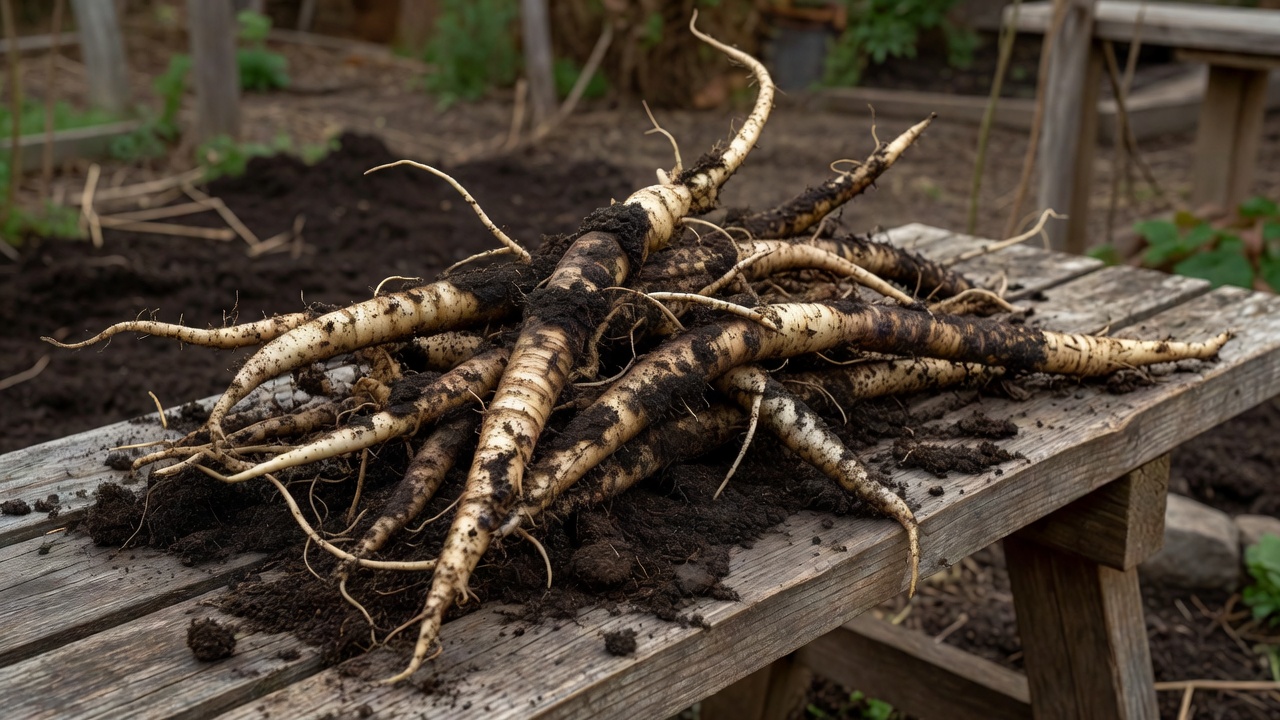
If you were to walk through a well-tended kitchen garden in the 19th century, particularly in Britain or France, you would undoubtedly encounter rows of a long, slender, unassuming taproot. This is salsify, a vegetable that enjoyed immense popularity during the Victorian era before mysteriously vanishing from commercial agriculture.
To modern eyes, salsify looks like an undernourished parsnip or a pale, rigid dandelion root. Yet beneath its rough exterior lies a delicate, creamy white flesh with a flavour profile so unusual that it earned the nickname "the oyster plant."
White Salsify vs. Black Scorzonera
When discussing this root, it is essential to distinguish between two botanically distinct but culinarily interchangeable plants. True white salsify (Tragopogon porrifolius) produces a pale, cream-coloured root and distinctive purple daisy-like flowers. Black salsify, or scorzonera (Scorzonera hispanica), is entirely different. It possesses a dark, almost black skin, yellow flowers, and is generally considered superior in texture by traditional French chefs.
Both belong to the aster family (Asteraceae), alongside sunflowers and dandelions. While their skins differ wildly in appearance, peeling either reveals a stark white interior that oxidizes rapidly upon exposure to air, demanding immediate submersion in acidulated water—a fussy preparation step that likely contributed to their commercial downfall.
The Flavour Profile: Does It Taste Like Oysters?
The comparison to marine bivalves is pervasive in historical texts, but modern palates may find the description slightly exaggerated. The taste of salsify is profoundly earthy, with distinct notes of artichoke heart, asparagus, and a subtle, saline minerality.
"It is the faint maritime brininess, noticeable particularly when the root is boiled and mashed with butter, that cemented its reputation as the poor man's oyster."
When prepared properly—steamed until tender, then sautéed in brown butter—the exterior caramelizes while the interior takes on a silken, melting texture that truly justifies its historical acclaim. It pairs impeccably with cream, white wine, thyme, and lemon.
The Decline of Salsify
Why did such a prized vegetable disappear? The answer lies in the demands of 20th-century agriculture. Salsify is notoriously difficult to harvest. The roots can easily grow over a foot long and are incredibly brittle. Attempting to pull them by the greens results in snapped roots, which rapidly dry out and spoil. They require deep, careful trenching to harvest intact.
Furthermore, their knobbly, irregular shapes make them difficult to clean mechanically, and the necessity to peel them immediately before cooking frustrated the convenience-focused mid-century housewife. In an era where the perfectly smooth, robust carrot became the standard, the delicate, demanding salsify simply could not compete.
Cultivation and Revival
Today, finding fresh salsify in a standard supermarket is nearly impossible, though high-end farmers' markets occasionally offer scorzonera in late autumn. For the home gardener, however, it remains an incredibly rewarding crop.
- Sowing: Sow directly into deeply worked, stone-free soil in early spring. Stones will cause the roots to fork.
- Frost tolerance: Salsify actually improves in flavour after a frost, as cold temperatures convert the plant's starches into sugars.
- Storage: The roots can be left in the ground overwinter and harvested as needed, making it an excellent winter survival crop.
As culinary trends continue to pivot back toward heritage ingredients, slow food, and hyper-seasonal cooking, salsify is slowly making a return to tasting menus. Its rich history and unparalleled flavour make it a forgotten food well worth remembering.